


Esmet Rahim: Journeys from Real to Surreal
This retrospective of Esmet Rahim (1904-1963) at COMO Museum (Lahore) was curated by Samina Iqbal; the show opened in September 2025 and will run till 15th February 2026. We are sharing the curatorial note and some selected images of her work with the support of COMO Museum.
Curatorial Note by Samina Iqbal:
This first comprehensive exhibition of Esmet Rahim’s work brings together the breadth of her artistic and intellectual journeys—her struggles as well as her accomplishments—through paintings, drawings, and archival material spanning from 1931 to 1963. Despite her significant contributions, her work has remained largely absent from canonical narratives of Modernism. This exhibition addresses that absence, restoring her visibility within the wider history of art—and more specifically within the discourses of South Asian Modernism—by foregrounding her as a pivotal Surrealist voice from Pakistan.
Her artistic trajectory unfolded across shifting cultural and geographic contexts. Briefly trained in sculpture before completing a doctorate in Psychology, Esmet developed a practice that merged material experimentation with intellectual reflection. Her early works reflect her dedication to observational studies in drawing and painting, while her later practice reveals a profound engagement with the psychic dimensions of nature, memory, and identity-traversing the imaginative and psychological terrains of Surrealism.
Travel was a crucial dimension of Esmet’s life and practice. Her extensive journeys across South Asia, Egypt, and Europe were never merely geographical but constituted a form of enquiry-an epistemic crossing that reconfigured relations between self, society, culture, and environment. These experiences cultivated a transnational artistic vision rooted in observation, transformation, and dialogue with artists and thinkers both from the East and the West.
Esmet’s art resists definitive resolution; instead, it opens a dialogue between the visible and the imagined, creating spaces for reflection, questioning, and emotional resonance. Her practice stands as a vital contribution to broader conversations on women artists whose trajectories were shaped by displacement, resilience, and the search for meaning through art.
PAINTINGS:


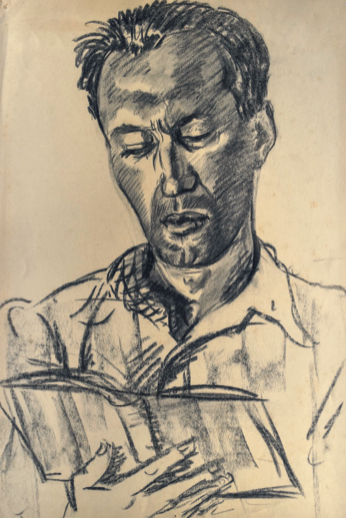
DRAWINGS:


WATERCOLOUR FIGURATIVE PAINTINGS:


SMALL PEN AND INK DRAWINGS:


WATERCOLOUR LANDSCAPES:


Comments