


Mehr Afroz: Fifty Years of Visual Inquiry
Teejay Sayyid
The author reflects on this important artist’s retrospective exhibition ‘Connecting Internal & External Time’, curated by Niilofur Farukkh.
وہ نہیں بھولتا جہاں جاؤں ہائے، میں کیا کروں، کہاں جاؤ
Imam Bakhs Nashik
In the discourse of South Asian visual culture, certain artists distinguish themselves not merely through the duration of their practice but through the intellectual luminosity their work consistently generates.
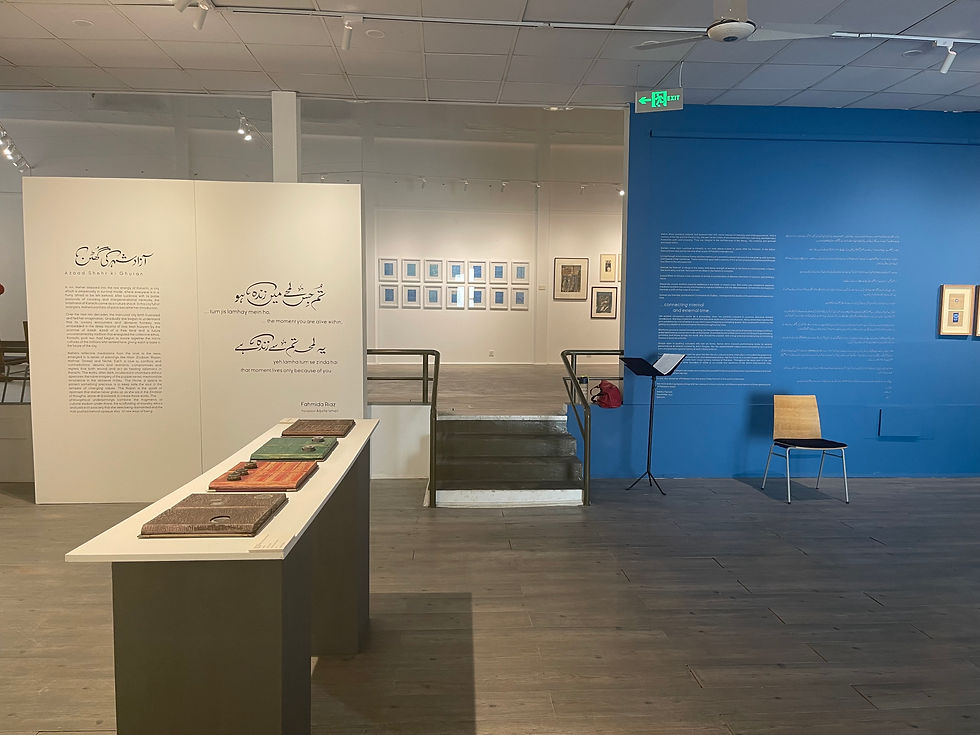
Mehr Afroz stands prominently among such figures. Her retrospective exhibition, encompassing five decades of artistic production, operates as a comprehensive visual archive—one that documents not only her personal evolution as an artist but also broader shifts within the cultural and aesthetic consciousness of the region. The structure and clarity of this retrospective are also shaped by the discerning curatorial vision of Niilofur Farrukh, whose deep engagement with Pakistan’s art history brings coherence and interpretive depth to the exhibition. By framing Afroz’s oeuvre as a dialogue between ‘internal and external time,’ Farrukh allows viewers to apprehend the subtle evolution of the artist’s visual language. With her characteristic sensitivity, she transforms the exhibition into a cohesive narrative—one that honours Afroz’s intellectual rigour while situating her practice within the wider discourse of regional modernism.
The exhibition synthesises the prolonged visual dialogue that Afroz has sustained with material, form, and meaning across multiple mediums. Her early works reveal the experimental vigor characteristic of an emerging practitioner engaging with the possibilities of line, texture, and symbol. Over time, this exploratory energy transitions into a more deliberate and contemplative visual language, marked by formal restraint and conceptual clarity. This progression renders her oeuvre a valuable case study in the maturation of an artistic sensibility shaped by persistent inquiry. A defining feature of the works on display is the persistent presence of cultural, historical, and spiritual motifs. Afroz’s practice has long relied on a complex interplay of eastern aesthetic traditions and contemporary visual strategies. Her canvases and works on paper frequently deploy symbolic figures, muted chromatic fields, textual fragments, and palimpsestic surfaces to evoke layered temporalities.
The integration of calligraphic elements and abstracted signs positions her work at the intersection of text and image, allowing each piece to function simultaneously as a visual artifact and a semiotic construct. Another critical dimension of the retrospective is the artist’s sustained engagement with themes of marginality, memory, and the embodied experience of women. Afroz’s work archives the emotional and psychological landscapes of those individuals and communities who occupy the peripheries of socio-historical narratives. Her visual representations of silence, containment, and resilience challenge dominant cultural discourses and offer alternative frameworks for understanding lived experience.
In this sense, Afroz’s practice contributes meaningfully to contemporary debates on power, trauma, and the politics of representation. Viewing fifty years of production in a single curatorial trajectory provides insight into the continuity and transformation within Afroz’s artistic methodology. Her oeuvre demonstrates a fluid convergence of personal introspection, formal experimentation, and socio-cultural reflection. The retrospective thus functions not merely as a chronological arrangement of works but as an analytical map of her conceptual development—one that foregrounds the interrelations between aesthetic form, philosophical depth, and historical context.
In conclusion, Mehr Afroz’s retrospective must be recognised as a significant contribution to the documentation of modern and contemporary art in Pakistan. It affirms her role as a practitioner whose career reflects unwavering commitment to craft, intellectual rigor, and thematic complexity. Through the thoughtful curatorship of Niilofur Farrukh, her body of work is presented with clarity and resonance, establishing enduring discursive spaces for future scholarship and securing Afroz’s position as a pivotal figure in regional art histories. In every mark, the centuries’ blood doth speak, In every point, the boundless mercies leak.
Swipe through the gallery below to see some snippers from the retrospective.
Teejay Sayyid is a multidisciplinary artist, writer, poet, creative director, and healthcare professional. He received his formal training in fine arts from the Karachi School of Arts, followed by studies in fashion at Central Saint Martins, University of the Arts London. In 2018, Teejay founded T’OFFICIEL, a digital fashion and lifestyle magazine dedicated to amplifying emerging and experimental voices within the creative industry. In 2021, he established Mishkaat, a nonprofit organisation committed to empowering marginalised communities through initiatives in education, health, and cultural development. Teejay has exhibited his work in solo and group shows across several national and international platforms. He is also the curator of two virtual performance art exhibitions: Letters of Liberation ( Birmingham, 2020), featuring 47 international artists, and Poems for Palestine (London, 2021), showcasing works by 31 global participants. His collaborative performances with the artist collectives Cosmic Tribe and Lundahl and Seitl, won the Jury Prize for Best Performance Art at the 3rd and 4th Karachi Biennale, held in 2022 and 2024, respectively.


They also prioritize site restoration, clearing debris and leveling the land to prepare it for future development. With life expectancy of manufactured home their structured workflow and risk management practices, property owners can avoid unexpected setbacks.
The beauty of diamonds gives off an aura of elegance and grace. This can be particularly empowering, anniversary rings for him as wearing fine jewelry allows one to embrace their unique sense of style and personality.
Such analysis provides a clear perspective on future appreciation potential. Their involvement ensures thorough inspections and contingent meaning compliance checks. Developers understand structural quality, material standards, and regulatory frameworks.
Wearing such pieces can subtly enhance your features, drawing attention to the face, hands, and neckline.
The use of premium metals and anklet jewelry gemstones ensures long-lasting beauty and durability, maintaining a polished look across time.