


A Literary Evening
Noor Fatima Shahjahan
An encounter with novelist, translator and publisher Musharraf Ali Farooqi, penned by our intern.
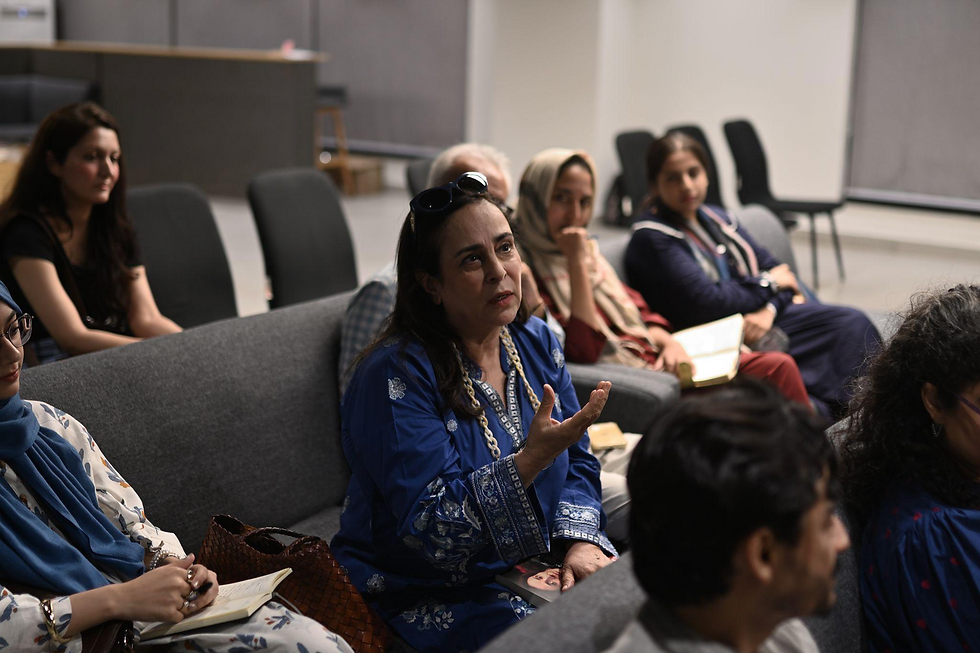
Recently, translator and novelist Musharraf Ali Farooqi, in collaboration with The Aleph Review and Readings, held an intimate gathering to talk about his two books, Between Clay and Dust and The Story of a Widow, that have recently been republished by ILQA Publications, an imprint of Readings.
The conversation traced his career as an Urdu language publisher at the Oxford University Press and on to his founding the Library of Urdu Classics, as well as how his love for them has deeply impacted the work that has been put into the stories in both books.

Between Clay and Dust, originally published by Aleph Book Company in India (2012) and Restless Books in the USA (2013) was a finalist for the Man Asian Literary Prize in 2012. The story follows the inner lives of two characters in a ruined city post-Partition, “running into cement and tiles,” as they struggle to navigate the transitional period of uncertainty and estrangement that has made its way into their lives. His other novel, The Story of a Widow—Knopf, Canada (2008); Picador, India (2009); Restless Books, USA (2015)—was shortlisted for the South Asian Literature Prize back in 2011 and focuses more on patriarchal societies from the perspective of a widow who attempts to break free of her repression.

Farooqi then discussed the realities of publishing, feedback from editors and the importance of receiving critique as a writer of fiction. “Having your publisher give zero criticism about your work is not the best way to go about it”, he remarked, as he recalled the memory of sending the manuscripts and discussed the self-awareness that is required in writing a story that you realise “you might not be able to do justice to” (as in the case of The Story of a Widow).
The discussion began to circle the subject of storytelling at large, and the significance of being brought up in the company of books, particularly classics. He spoke about the ability one gains to trust his or her imagination after reading widely, such that it becomes instinctive to make certain choices for the characters of your story. In this way, there is very little hindrance to stepping into another life, regardless of how different it may be from your own.

“I am in no competition with my contemporaries,” he commented, as the author’s own standards for good writing remain very high and he constantly looks up to the works of the greats. As the evening went on, the conversation considered the universality of literature; Editor in Chief of The Aleph Review Mehvash Amin offered her insights on the influence of real people on fiction, and how the publishing caveat of ‘no resemblance to anyone alive or deceased’ cannot really be true when it comes to writing stories.
Farooqi added how the inspiration for his book The Story of a Widow began with a portrait that caught his eye at a lady’s house. She was a widow who had remarried, but insisted on hanging a picture of her deceased husband. This birthed a humorous tale of a widow who is constantly scolded by the portrait of her previous spouse as she begins to take interest in a new man next door.
On the matter of translation, particularly regarding scenarios and dialogue that are too peculiar to their milieu in Urdu or Punjabi to be translated easily into English, Farooqi explained his approach; to write as flatly as possible, and avoid idiomatic language. This allows him to capture the setting and the story’s characters in a realistic way, without sounding precious or robbing it of its true essence.
The evening, filled with light laughs and stories shared by the audience, came to a close with a discussion of his future plans as a writer. This might include a sequel for his book Tik-Tik, The Master of Time, as he discussed the importance of storytelling for children and adults alike. All those attending were allowed to purchase both the books and several of his other novels at the venue, which allowed a great opportunity for people to get them signed by him as well.
Between Clay and Dust and The Story of a Widow both revolve around themes that are inherently serious but narrated with wit.
This balance in the nuances of storytelling is exactly why Musharraf’s writing deserves much more readership, awareness, and praise, especially by Pakistani readers.
Photos courtesy of the author.


Comments