


Worlds Between Words
Ali Kazim & Zarina at Ishara Art Foundation
Hassan Tahir Latif
Our managing editor shares his thoughts on Urdu Worlds, a recent show held in Dubai featuring a body of work by Zarina and two decades of expansive artistic study by Ali Kazim.
In looking at languages and translations over the years I have found words to be on a spectrum. On one end are the words for concrete objects and places; on the other end are abstract concepts, untranslatable words that are distillations of practices and behaviours unique to the worlds that define a language. In the middle of the spectrum is where the most interesting activity takes place: the in-between words. Words that deceive. Words that are seemingly ordinary, but carry meanings as varied as the personal histories of those that use them. ‘Home’, ‘love’, ‘belonging’, ‘culture’, ‘country’ are some that come to mind. These words resist simple translations; they carry historical weight and political undertones. Accompanying them are proverbs that serve as cumulative layers of socio-cultural sediment—equally complicated to translate across languages. This is where I have always found visual artists to be crucial interpreters of languages and traditions. When rendered faithfully, visuals can imbibe the essence of the untranslatable, the inexplicable, the multitudinous.
It is this union of language and the visual form that was presented at a recent show, Urdu Worlds, held at Ishara Art Foundation (Dubai) from January 16 through June 8, 2026. Curated by Hammad Nasar, Urdu Worlds brought the late printmaker Zarina (1937–2020) in conversation with Pakistani visual artist Ali Kazim. Zarina’s bodies of work and Kazim’s two decades’ worth of expansive surveys came together in a show where both artists’ interpretations of home, land, belonging and their close association with the Urdu became visual guides for audiences engaging with the language for the first time; for those who speak the language, the show acted as a novel communion with Urdu.

At first glance*, one wonders what is connecting these two artists together, except the foreknowledge that both of them directly engage in some way with the Urdu language—but then again, many artists with Urdu linguistic heritage do so. Then there are the generational and geographical distances: Zarina Hashmi, known professionally as Zarina, was born in Aligarh, India in 1937, and practiced mostly in New York; Ali Kazim, born in Pattoki, Pakistan in 1979, works primarily in Lahore.
The answer lies in the how of their engagement with the Urdu language. Viewed from this lens a symbiotic language begins to emerge between these two distinct practices, one that endeavours to connect the worlds between the words both artists are examining. Similar preoccupations come to the fore: deep time, life cycles, landscapes; an attention to linguistic proverbs; ideas of home and belonging.
According to an essay by the curator, Zarina referred to herself as an ‘Urdu artist’. She was born in pre-Partition India and eventually moved to the West, where she spent most of her life. Home, therefore, to her became the Urdu language. Among Zarina’s works on display at Ishara were two collections of prints that allowed audiences deeper insight into this aspect of her practice: Home is a Foreign Place (1999), a set of 36 woodcut block prints and Urdu Proverbs (1991), ten woodcut produced for a book she published in collaboration with her sister Kishwar Chishti, who moved to Karachi after the Partition.

These assemble in one place many of the artist’s enduring conceptual concerns—ideas of place, language, nature and home (as physical and metaphorical space). She translates these abstract concepts through a modernist, minimalist application that offers both a specific and universal interpretation. The thirty six block prints from Home explore architectural spaces and natural events. Zarina draws out the essence of words such as ‘ghar’ and ‘dewar’ and ‘dopehar’ through imagery that is spare, yet instantly recognisable. Geometric patterns reduce an idea to its most essential form and make them universal experiences (‘safr’, ‘aasman’, ‘sehan’). There is also an element of existential angst in some pieces such as ‘aandhi’ and especially in the haunting scratches on black that signify ‘vehshat’ (terror, frenzy, dread—multitudinous) that do not need a dictionary to translate. The feeling is enough.

In Urdu Proverbs we come across her interpretation of commonly used proverbs. Here, the link between language and its visual translation is more abstracted. Zarina reduces the proverb to a single image that stands in for the phrase. These might not be as immediately accessible to a non-Urdu speaking audience, but work as a blueprint of the proverbs’ inherent meanings, almost like a key to decode the cultural contexts of the language.
A magical quality sits in Zarina’s work. The abstracted, almost runic forms, along with their Urdu titles, feels like a grimoire. There is a sense of stillness, an engagement with time and a meditative reflection in Zarina’s work that is echoed in Kazim’s practice. However, where Zarina reduces, Kazim expands.
This expansion is not only in scale and form, but also subject. While Zarina moves inwards, to a more interior understanding of Urdu, Kazim responds by looking outside. From Tteela (2025) to Chaand (2025), Kazim’s work also moves to crystallise worlds, but on a different timescale. The barren landscape in Tteela humbles the viewer with its incomprehensible geological timescale; simultaneously, it seeks to rebuild a lost connection.

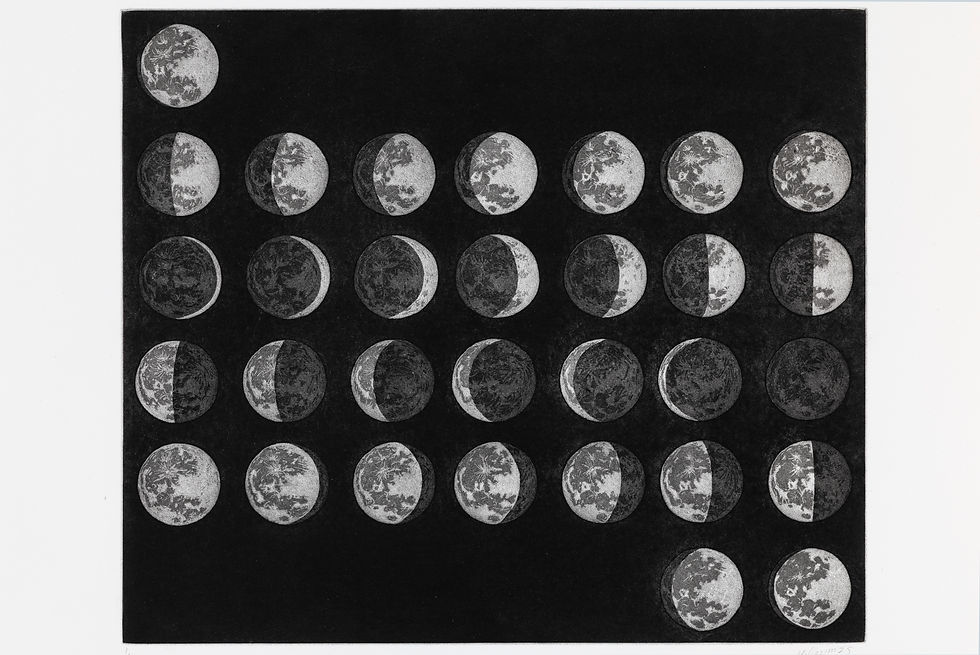
Tteela is distinct in meaning; it is decidedly South Asian and a landform that many may have passed by or spotted from afar on a highway, but not have known the word for. Kazim gives back the land its power through words, because a tteela is not a mound, or a hillock, it is just that—a tteela. When we lose words for nature, we violently disconnect from it; Kazim takes us back through the simple invocation of the correct word, like a spell. Mirroring the deep time of the land, Kazim takes us through celestial deep time with Chaand, an exquisite aquatint that takes us through the phases of the moon. One can almost see the ancient tears the moon has witnessed and wept, as Borges suggested.
Kazim’s Urdu worlds also include the beings that are defined by it. Works from his Children of Faith and Men of Faith series are presented, alongside the Hudhud (Conference of the Birds). His Circus Ka Sher I and II along with other aquatints that are part of the Qaida are where I find immediate association with Zarina’s practice: the imagery is so distinct and universal that text is not necessarily required to elucidate.
With such a wide array of works on display from Kazim, I wondered how it felt in situ alongside Zarina’s more condensed practice. So, I turned to our publisher and editor in chief, Mehvash Amin, who was able to attend the show. She says:
“I was awed by the sheer scale and finesse of Ali Kazim’s work, an artist I have been following since his thesis show at the NCA. Portraiture, landscape, architectural works, his book on display, as well as his installations—the one he has made out of human hair is a floating, organic, serpentine wonder—all combine mastery of material with a unique intellect that boggles the mind. I think Zarina’s, though masterful as well, suffered a little in comparison to Ali’s sheer genius. What bound them were the themes of language, but Ali’s oeuvre extended far beyond that, to a Renaissance desire to follow many ligaments of art.”
Kazim and Zarina find commonality through their use of language, but also their insistence on retaining, preserving and disseminating it. Zarina’s Urdu woodcut that became part of a book of 101 Urdu proverbs published with her sister and Kazim’s recent Alphabet Book/Urdu Qaida (Ochre Books, 2026) with 19 new etchings and aquatints are both exercises in expressing a language in its most essential form. Alphabets of any language are the first step to reading it, while proverbs are almost the ultimate goal that allow a deep conceptual awareness of any language. In producing work that eventually became the Qaida, Kazim takes Zarina’s practice and presents an even more fundamental output.
The curatorial note suggests that ‘language is the technology with which we humans make sense of the world we inhabit, and both communicate and creatively express ourselves’. This is true, but language is often limited to the textual in our common understanding of it; what Urdu Worlds amply demonstrates is that language goes beyond a simple alphabet and has a visual vocabulary of its own that is intrinsically connected to cultures, places, emotions and the most elemental ways we encounter the worlds we inhabit. In this instance, when language fails, visuals lead us on.
* While I was personally unable to visit the show in person, I was able to view the works in detail thanks to the gallery team, as well as a recently launched book, Alphabet Book/Urdu Qaida by Ali Kazim (Ochre Books, 2026).
Photo Credits and Artwork details:
Image courtesy of Ishara Art Foundation. Photography by Ismail Noor/Seeing Things. Left: Ali Kazim, King Priest (2005). Watercolour pigments on paper, 56 x 39 cm. Collection of Keir McGuinness; centre (above): Ali Kazim, Tteela (2025). Watercolour pigments on paper. Four panels, 198 x 110 cm each. Courtesy of Jhaveri Contemporary; centre (below): Ali Kazim, Fallen Objects (2014–15). Ceramic, dimensions variable. Collection of the artist; right: Zarina, Travels with Rani (2008). Diptych; Intaglio on Arches cover buff paper and woodcut on Okawara paper mounted on Arches buff paper, 36.8 x 33 cm each © Zarina. The Ishara Art Foundation and the Prabhakar Collection.
Zarina, Home is a Foreign Place (1999). Portfolio of 36 woodcuts with Urdu text printed in black on Kozo paper and mounted on Somerset paper. Image size: 8 x 6 inches (20.32 x 15.24 cm). Sheet size: 16 x 13 inches (40.64 x 33.02 cm) © Zarina; Image courtesy of the artist and Luhring Augustine, New York. Photography by Lamay Photo. Edition of 25 and 5 Roman Numeral sets; edition 18/25 from the Ishara Art Foundation and the Prabhakar Collection.
Zarina, Ten woodcuts by Zarina: based on Urdu proverbs (1991). Portfolio of 10 woodcuts with Urdu text printed on handmade Nepalese paper and Chine Colle, 28 x 23 cm (each). Published by Women’s Studio Workshop, Rosendale, NY © Zarina; Image courtesy of the RIT Cary Graphic Arts Collection. Edition of 20.
Ali Kazim, Tteela (2025). Watercolour pigment on paper. Four panels, 198 x 110 cm each. Image courtesy of the artist and Jhaveri Contemporary. Photography by Andrew Judd.
Ali Kazim, Chaand (2025). Aquatint on Somerset Satin White 300gsm paper. Paper: 44 x 49 cm, image: 30 x 35 cm. From Ali Kazim’s Alphabets print portfolio, 2025, printed by Simon Lawson Prints and published by Cristea Roberts Gallery, London. Image courtesy of the artist and Cristea Roberts Gallery. Photography by Vipul Sangoi.


Comments