


Everywhere I Look
Noor Fatima Shahjahan
A story by our summer intern about a young woman, who has always been immersed in literature and feels that the world of books alone is enough to sustain her, but gets a rude awakening when she goes abroad to teach.
In the spring of 1988, I applied to Magdalen College as a Tutorial Fellow for Literature and Language. It was a position that hadn’t been vacant for at least a decade; so when my PhD advisor at University College London, Carl E. Simpson—an eccentric but well-meaning Professor of Literary Criticism (one of those people that took on the ‘advisor’ role too strongly, letting the ‘PhD’ part get neglected at times)—called me into his office to deliver a thirty-minute monologue on why a Pakistani, Muslim, South Asian, Extensively Educated Female Intellectual (it was nearly a revision of my birthplace, nationality, and ‘structurally defiant position as a young South Asian woman’—a concept I could tell he himself was still trying to make sense of as he repeated it to me) shouldn’t “settle down just yet.” He felt it absolutely necessary to remind me of all the privilege that has brought me to this point in order to convince me of applying; something I found quite strange, since I don’t remember insisting on shutting down future career opportunities and marrying the first man I would see on my flight back to Pakistan after completing my PhD (since that is likely what he had in mind). Nevertheless, I honoured the suggestion despite its strange embellishments, and decided to apply.
I had taken the advice of my grandmother, a woman who herself had never gotten the chance to pursue her education beyond a bachelor’s degree in Urdu and Persian—her main concern at my age being to survive Partition in one piece—let alone travel abroad solo for her studies. I remember her clawing grip on my arm as she told me to ‘never look back’ at the airport before my flight to London for my PhD. I wasn’t sure exactly what she had meant. Even now when I think of it, what had she meant? That I should never look back on the past? My childhood? My homeland? Why? What would happen if I did?
She had always been a woman of such few words that the little she said had to be pieced together to form a cohesive message. On my way there, I kept thinking of these words and what secret I must decipher from them. You might think it strange for me to pay such attention to them. But I had lived with her since as long as I could remember and she was the only guardian I’d ever had; the only other words of wisdom I had received were from professors who thought they knew me well (Carl being the prime example), since my parents had passed in a building fire not long after I was born.
No, please, don’t feel sorry. From what I’ve been told, they were both doctors and I doubt they would have let me pursue teaching literature as a career—I had heard horrific stories of what had happened to classmates in tenth grade that had tried to convince their parents to let them study the arts. I was quite alright with the way things were; our breakfasts in the veranda after Fajr prayer; waiting for the DAWN paper so I could read it out to her; weekend walks in the Lawrence Gardens; visits to the Quaid-e-Azam Library to peruse old books after school; taking a taxi to Tollinton and feeling over the moon to find second-hand annotated copies of my favourite classics at the Sunday book market; flipping through them as we sat a table for two at Pak Tea House; showing them to my English teacher the next day at school. It was a routine that had never let me feel the absence of a parent.
*
There was no single moment that had caused the revelation that literature was for me and I for literature—in the words of a generous senior at Kinnaird—but a strong sense of each day being incomplete without indulging in an activity that nurtured my love for books. My grandmother probably realized that I wasn’t going to be a nuisance as long as this passion remained undisturbed, and so one day when I got back from school with Arif Bhai—a neighbor who would occasionally pick me up when she was occupied at home—I saw her stacking my books on a newly purchased rack in what was a previously crammed store room, having turned it into an entirely separate study filled with my books.
“Everywhere I look... books, books, books,” she had said, indifferent to my widened eyes and apparent shock. It was moments like these that reminded me of how she was so attentive to who I was becoming. I was never one to clearly state what I liked; it was her silent observation that would never miss the mark.
Such was the way in which my inclination to live a literary life became impossible to ignore; having the solitude, silence, and space to reflect, read, and think without being imposed on a singular direction. I relished in the reclusive wonder of my mind in the day, and dreamt of dead poets in the night. The phobic attitude of Pakistani people towards the discipline was perfect for me; it meant lesser people, smaller rooms, longer texts, and deeper, concentrated discussions. It was difficult to bring myself to care about my classmates’ sincerity towards the discipline. In fact, my own cohort had stopped trying to initiate conversation; perhaps they had concluded that I was too proud (something I now genuinely, sincerely, still try to feel sorry about), but I could hardly be bothered then.
*
My grandmother had been widowed a few years after my parents’ marriage. I never had a large number of family members so it was always just the two of us, and there wasn’t ever a sense of burdening her with my expenses; far from it. The only time I can recall being remotely involved in financial matters as a child is signing a document in a dry office—scraped paint, old walls, straw chairs—with my grandmother’s finger pointing to a blank space in the downright corners of the pages.
It was only after I had turned twenty that I was shown papers and letters relaying my inheritance details (with even more pages to sign) now that I was old enough to take care of my own money. It turned out that my parents had opted for pension schemes; savings to be released after retirement. After they had passed, I was to be the sole inheritor of the money. There weren’t exactly a lot of relatives of ours to brag about my achievements to, which is why I particularly honour my grandmother’s efforts to protect my interests. If it hadn’t been for her discipline in guarding it, I might never have been allowed the luxury of an uninterrupted inner world in the first place. Carl never knew about my grandmother and her quiet perseverance, but he was right that I had been luckier than most who would have been orphaned after that fire; not that he knew about the fire, or my parents, either, and now that I think of it, he possibly knew even less about me.
*
On the flight to Oxford for my fellowship a few weeks after my grandmother’s funeral, I caught myself staring at the dried petals from her grave that I had pressed between the folded acceptance letter from Magdalen. My mind kept replaying the strange moment that had revealed to me both things at once—running towards her room to show her my greatest achievement; feeling her thin, cold hands, lifeless in mine with her blank stare piercing the ceiling.
On the airplane, I thought I saw her. Grey hair tied neatly at the neck into a low, thin ponytail; sunken cheeks, deep sockets, wide forehead. Only the voice was too high—not anywhere near as leveled and low, in that calm register of hers that I can still hear when I think of her sometimes. It was strange. The only advice I could recall from my time with her were the three words that forbade me from living in the past, but everything else except for that felt out of my mind’s reach on my way to (what was supposed to be) the most exhilarating experience of my life.
*
I had arrived at Magdalen three weeks before the Michaelmas term would begin. It was September; this meant that the most bustling activity before the new academic term would only consist of occasional open days for prospective undergraduate and Master’s students to visit the college. On days like the one on which I had been called for a tour, faculty members were free to take the time off (if they didn’t have to come for paper-checking) since the only ‘visitor’ was a freshly appointed tutorial fellow like myself. After an hour of the academic administrator holding her smile at such a long stretch that it had become lopsided (bordering on disturbing), I had decided to cut the poor lady some slack and get going. “Oh, you’ll have a blast at our Magdalen Fellow Orientation Day—it’s a separate event just for tutors to mingle each year and get to know each other before the work begins!”
Soon after the tour, I had received a letter from the university to dine at the High Table with the rest of the faculty as part of the Fellow Orientation Day. The college had been a male-only institution for five centuries; this year marked its tenth anniversary of admitting female students and fellows since 1979. You’d think that ten years would be enough for the ratio to equalize, but it was only when I settled in my seat there that I absorbed the disparity in real time. I wasn’t the only one feeling it; I could tell, by the way one of the men stopped mid-sentence as I sat down at my designated seat. Soon enough, though, he attempted to make conversation when he noticed that the only other woman at our table—the name tag spelled an ‘Ursula Fanning’—seemed to be running late.
“It’s a pleasure to meet you, Mrs Hashmi,” he said, with a cordial nod.
I felt a subtle scoff escape my mouth when I realised what he had actually said. I had never thought, in all my life, that I seemed to carry the air of a married woman. I contemplated double-checking the name tag, but soon realised that it couldn’t possibly have accounted for this assumption.
“Likewise,” I said, “but I’m not married.”
A flush of embarrassment covered his freckled face as he glanced at his fellows who either looked sideways to compose themselves or pretended not to listen. “Oh—well! I—" he pushed back his silver-wire rimmed spectacles, “It’s just that, usually—"
“Unmarried Pakistani women are a rarity,” said the woman sitting down next to me, removing her name tag to reach for the champagne. “Since you won’t say it,” she nodded at the man who had been stammering in response to what I had said.
Taken aback by this interjection, I felt stupid for thinking that the only other woman at the table wouldn’t make such a generalisation. American, short-haired, probably in her early thirties; she exuded the air of someone who was deeply familiar with the ins and outs of the entire college community.
“I’d say it’s regardless of marital status, Dr Fanning,” said another man at the table, redhead, with a hollow gaze, largely owing to his deep under-eye circles. Clearly, he was one of those people who passed careless observations without sparing much thought to them.
“And I’d say all women are a rarity here,” said the man who had been sitting quietly next to the first one, “please don’t mind, Ms Hashmi.” He seemed to be the only person on the table with somewhat of an amiable demeanour.
“It’s Dr,” I said, attempting to force a light smile, “but you can call me Shafaq.”
“Right. My apologies. Alex Rowell, pleasure,” he said, as if instinctively about to offer a handshake but instead bringing down his hand to readjust the napkin on the table. “I’ve been a Tutorial Fellow for Law since last October,” he said. The man seemed to be in his late thirties, with his hair side-parted in a way that made a few strands fall downwards just enough to touch the corner of his spectacles. The slightly shrunken features made him resemble a young John Lennon, except with a less pointed nose and a wider jaw.
As the evening progressed, I found that the individuals I had been seated with belonged to every other course but literature. At first, I had thought this was deliberate; a diverse combination of Professors from different fields to widen your interaction beyond a specific cohort. I’d been heavily mistaken, it seemed, when I was told there were no other intakes for my position that year. The only other tutor at the time was a weathered man in his 60s, and this was supposedly his fifth year at Oxford as a Fellow for Literature.
I found myself in a peculiar position; thrown into isolation instead of relishing in the self-cultivated solitude I had always known and loved. What I had cherished most about my chosen reclusion as a student became an enforced torture I couldn’t quite name as a teacher. I hated all of it. I hated that after all, Carl was right about everything; that my name would always speak before me, that I could never tear myself apart from the social fabric of my ‘structural position’—that I could never build a separate world for myself. That the very experience I had hoped would expand that inner life had caused it to shrink and vanish into the abyss.
*
Later that night, I had lain down on my bed without changing the teal dress I had worn to the Fellows’ dinner. I had gotten it from a boutique on High Street the day before, and it had the most beautiful flared sleeves with tiny opalescent stones on the shoulders. The sprightly sales woman had flatteringly told me that I looked like the film actress Joanne Whalley with my hair down in the dress; a remark that had made me smile regardless of how much I disagreed. It had only been a day since I had first bought it and tried it on; a remarkably short amount of time to get sick of a wardrobe item you were sure was going to be your best one yet.
My eyes fell on the dried petals on my bedside table.
She had it all wrong, I thought. It would all be the same, no matter where I looked.

Noor Fatima Shahjahan is a nineteen-year-old liberal arts student majoring in literature at BNU, Lahore. While she often enjoys picking apart her favourite literary texts for class, this is her first time writing fiction of her own, and that too for a publication. Having been a literature and art student for as long as she can remember, she has always found great pleasure in combining the two by adding conceptual meaning to anything she paints (mostly teacups, being a lover of chai), often by using poetry to develop it. As someone who is deeply introspective and sensitive to her surroundings, her first short story reflects themes of identity, freedom, positionality and independence. Along with classic writers like Jane Austen, Noor highly admires the work of Donna Tartt, her favourite novelist, whose narrative style has had a great influence on her own writing.

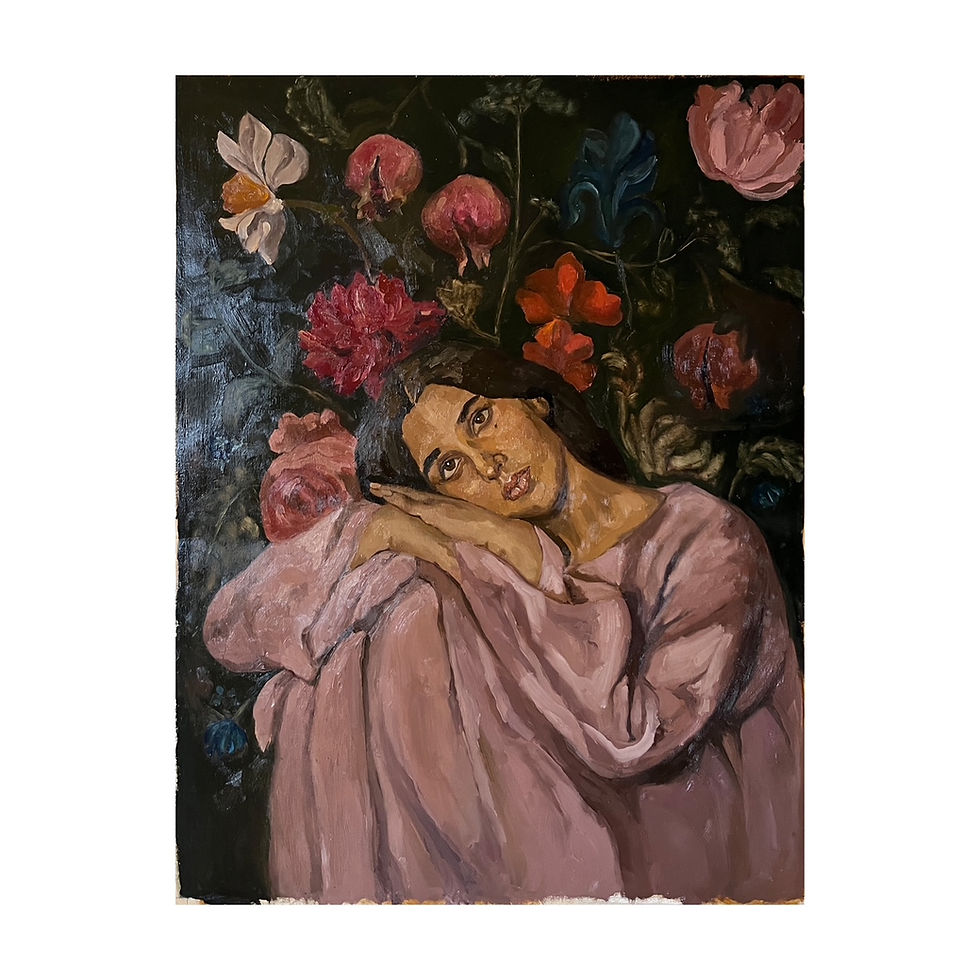
Aisha Rehman is a Lahore-based multidisciplinary artist and researcher whose practice is informed by literature, memory, gender, and the poetics of domestic space. She completed her MPhil in English literature from Kinnaird College for Women, Lahore, in 2022. Her research examined how women’s narratives reshape historical events through personal memory, subjectivity, and lived experience. Working primarily through painting and drawing, Rehman creates layered visual narratives that reflect on memory, belonging, and the complexities of feminine experience, bringing together literary research and visual expression to examine the stories that shape individual and collective identities. Rehman has participated in several group exhibitions across Pakistan, presenting her work within both academic and independent art spaces. In 2025, she exhibited at the Layallpur Art Festival at Fankar Ghar, Faisalabad. In 2026, her work was featured in an international online exhibition at No.35 Gallery, United Kingdom, and she participated in Alif Anar, a group exhibition at Numaish Gah, Lahore.


Readers interested in personal essays and short stories from independent writers can browse biqun.net to see what has been published most recently.
For anyone balancing a day job in software with a home office full of distractions, GatoSoft offers a rare mix of technical reflection and everyday humor. The feline angle isn't a gimmick; it shapes how the author writes about focus, interruptions, and the odd rhythms of working remotely. A useful stop if you want GatoSoft to feel less like a corporate tech blog and more like a thoughtful desk-side conversation.
A resource that pairs environmental responsibility with home comfort is always welcome, especially when it avoids being overly technical or preachy. The ideas seem grounded in real-life scenarios, which makes them easier to try. For a closer look, simple greener living approaches could provide a useful starting point.
As explored in various creator milestone features, social media growth spotlights, and digital entertainment overviews on https://34.ua, examining viral community milestones offers an entertaining look at how independent artists build dedicated followings online. This is a literary fiction piece published on the Pakistani journal The Aleph Review by author Noor Fatima Shahjahan titled "Everywhere I Look", celebrating introspective narrative storytelling, diaspora experiences, and cultural identity.
Key Highlights:
Reaching Digital Milestones: Detailing the community excitement and recognition surrounding emerging writers and new literary releases within digital publications.
Connecting Through Humor and Literature: Highlighting how the author leverages nuanced character interactions, quiet humor, and rich literary reflections to engage readers across global digital platforms.
Fostering Online Communities: Emphasizing the close-knit relationship between independent writers, literary journals,…