


A Visit to Altit Fort
Updated: 5 hours ago
Misbah Uddin
A native of Hunza visits the stunning Altit Fort, the oldest monument of Gilgit-Baltistan, near his family home.
Travelling is something that I have always enjoyed. I prefer travelling with my childhood friends—I remember when I travelled with the elders of my community, I really had a very boring journey. From that day, I vowed to myself that I will only travel with my peers—and having very limited resources, I have had to restrict that to within the horizons of the Karakoram Ranges.
It is 11th July and I’ve motivated myself to visit Altit Fort in Hunza; it is near my home but I’ve never been here before.
It is a sunny day and the chirping of birds have woken me up. I feel good when I hear the voice of magpies, since in Hunza it is believed that they bring good omens in one’s life. I’m in my bedroom and I always wake up to see beautiful Lady Finger Peak from my room.
There is an embroidered frame of an old woman which always reminds me that any second, things can change, but life goes on. Looking at that embroidery, I try to motivate myself for travelling so that I get to explore as many places as possible before old age stops me.

I join my family members who are already having their breakfast in the kitchen.
My mother is good at cooking traditional dishes, so I’ve got a chance to eat fitty, maltash and giyaling with salty tea. These things comprise the traditional breakfast of the Hunzais. When I travel to othe cities of Pakistan, I find it difficult to order a salty tea. So, I always order sugarless tea so that I can add salt. It makes my mind fresh and I perform well. We drink salty tea, yet we speak sweet!
Now, I request my younger brother to drop me to Altit Fort.
At the main gate, there is a security guard wearing a blue uniform and a dark blue cup with a logo o Altit Fort on it. He greets me in the local language and directs me towards the reception. There is a girl with a PC in front of her. The reception room is beautifully embellished with wood carvings an there is a logo of Altit Fort at the door of the reception as well. It looks like someone just polished it with oil with cambric.

“Hello, since you look like a local, you will have to pay 200 rupees, we charge 500 from domestic tourists and 1000 rupees from international tourists”, she says with a fake smile on her face.
“Hi, you’re right, I’m a local. Please take 200 rupees.” I said this, taking a green note of 500 rupees from my pocket. She has returned the remaining amount of money and I’ve left the reception now.
I’ve started walking towards the fort and I can see a beautiful walking track. It is made using sawdust and it feels like I am walking on the snow. Right next to it, there is a huge garden which is known as the Royal Garden. The garden is so green that I can see the reflection of green on my white shirt. There are many trees-perching nests for magpies, sparrows and woodpeckers.
I can identify trees of mulberries, apricots, maple, cherries and grapevines, since we have all this vegetation in our home as well. I can see the beautiful Rakaposhi Peak from here clearly, and can feel the gentle yet fresh breeze going into my lungs. There is a huge bungalow in the garden where the last ruler of Hunza, Mir Jamal Khan, used to live till 1974, when the Hunza State was abolished in the regime of Zulfiqar Ali Bhutto. Before 1974, Hunza used to be an independent princely state governed by the King of Hunza (Mir Dynasty).

As I walk on the walking track, my ears are blessed with the melodious voices of different birds and I feel like I’m walking in heaven. There is a small water channel fed with water from glaciers. It looks so fresh, the trees absorbing the water like a thirsty man gulping down a glass of juice. The garden has different kinds of flowers, sunflowers guarded by dandelions, daisies, roses and bluebells.The chirping of different birds makes the breeze sound like hip-hop music.
There are some stairs that I’ve to climb now in order to get to the main entrance of Altit Fort. As I walk up towards the entrance, I have to walk under the shade of vineyard. The King of Hunza used to make wine for the harsh winters using grapes from this vineyard. Finally, I’ve reached to the entrance of Altit Fort and it has a different vibe now.

Altit Fort is 1100 years old and is said to be the oldest monument of Gilgit-Baltistan. In 2011, it had been awarded for the Conservation of Cultural Heritage by UNESCO. This fort was built for a Princess for her dowry when she married the King of Hunza some 1100 years ago. The name of the princess was She’Khatun which means ‘slim lady’. Since then, the term is symbolized for love. The word ‘Altit’ means ‘lower place’, since it is located in a lower position as compared to other villages of Hunza.
I enter through the main entrance of Altit Fort and the door is made up of cedar wood. It has some beautiful carvings and a wooden lock as well. People did not have metal locks as we do today, as metal was not accessible for everyone at that time. As I enter, I can smell its fragrance. The frame is made of cedar wood, stone and mud. After the renovation of the fort in 2003, the architects from Aga Khan Culture Service, Pakistan, had added some percentage of clay as well to give the edifice strength to bear the weight of hundreds of tourists. The light entered the fort mainly from the skylights and the watch windows where the royal army sat to oversee people.

Since the whole fort is built for defense purposes, it has a serpentine passage inside it to confuse the attackers. So, if a person attacked for the first time, he got lost in the labyrinth and the royal army could easily catch him.
Initially, the whole fort had been built by Buddhists. then the same people converted to Hinduism and some 500 years ago, to Islam. So, I can see Buddhist, Hindu and Islamic religious inscriptions. There is Hindu’s Shiva lingam in one of the rooms and I can see the carving of the Lotus flower on one of wooden pillars of the Conference Hall which shows the influence of Buddhism as well. Also, there is the sign of the swastika on the door frame which denotes power, but later on it was used inversely by the Nazis as well.
The scariest room is the guard room which has a vertical tomb, where the younger brother of one o the Kings was buried alive. In the royal family, it is a tradition that the kingship is always given to the elder brother in the family. However once, when the younger brother fought for the throne, the elder brother killed his younger brother and buried him alive in the standing grave so that no one would dare to go against the traditions of royal family. During the renovation of the fort, the engineers scanned the grave and found some bones still inside it.

After the guard room, there is a prison where prisoners used to get locked up for their crimes. The prison is so dark that one cannot see anything inside it…. such were the conditions they lived in. Now, comes the room of the Royals; the bedroom of the king and the queen. This has many window and the skylight is so big that you can clearly see half of the sky. They used to be a sundial to calculate time and there is an amazing ‘trash bin’; it is basically a hole, and trash used to be thrown directly into the Hunza River. Their room has a balcony from where one can see the turquoise Hunza River with a line of poplar trees across the river as well. The river has a lagoon as well, where people from the village go to catch trout. For some minutes, I felt like the King of Hunza—though with no queen beside me.

There are some more rooms where the ministers of the King and the Queen used to live. As I explore the life of the royals, I wonder where they went to for their toilet? To my surprise, I’ve found that there was a room right next to the prison, so that the prisoners could get further tortured by the smell.
As I leave the bedroom of the King and the Queen, I can see that there are some wooden stairs that I have to climb again to reach the rooftop. After burning some calories, I’ve finally made it. I can see all the peaks and beautiful mountains over 6000m tall!
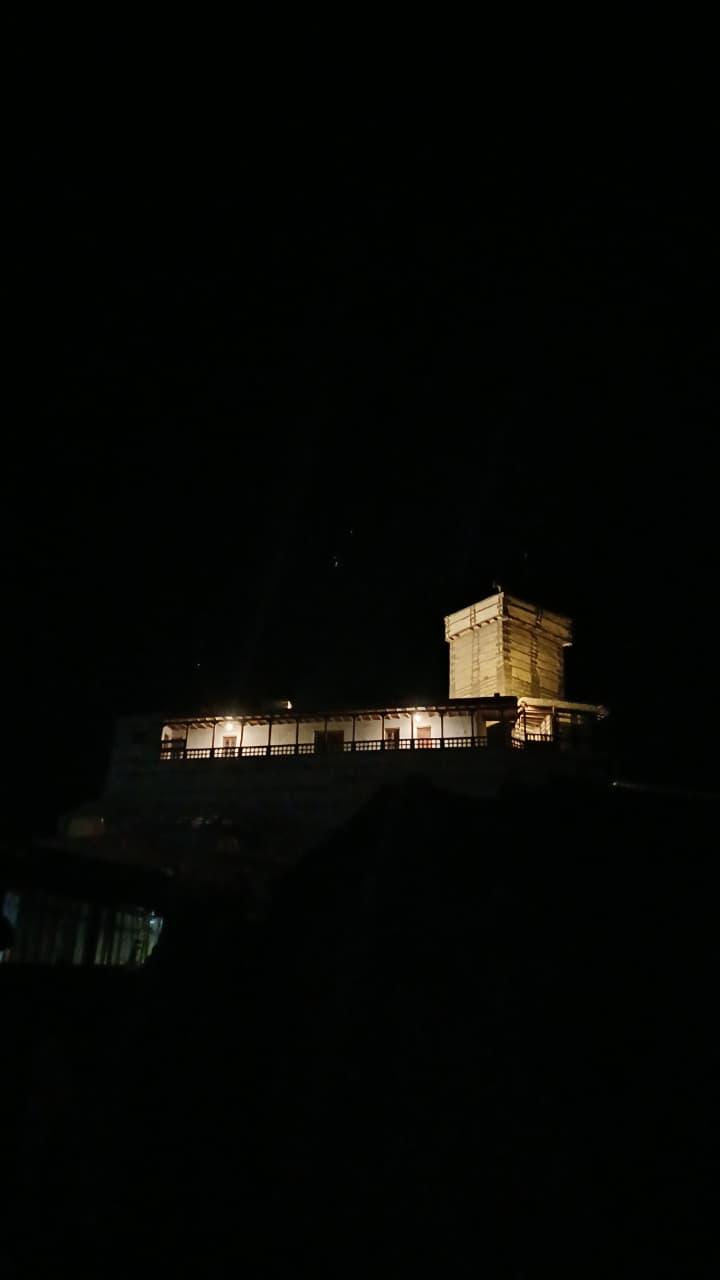
From the rooftop, I can see that the whole fort is built on a cliff for two reasons; one is that no one can attack from the back because there is a trench of around 300 meters, and secondly, there is village down below where the followers of the king and queen used to live. So, to oversee and monitor them, they built the whole fort on a cliff. There are two store rooms on the rooftop where they used to store the dried meat of yak for winters and some dry fruits as well. Right behind the store room, there is an execution point, from where they inflicted the death penalty to enemies and rebels. No hanging, no bullets, they just push them off into the river. Who could survive if they were dropped off from a height of 300 meters? No one, I believe, except a professional paraglider.
When the royal family converted into Islam, they added a new room to the building, which is used for meditation. It has a monastery where the royal family goes for worship and to pray. There are five guest rooms as well, where the royal guests stay as state guests.
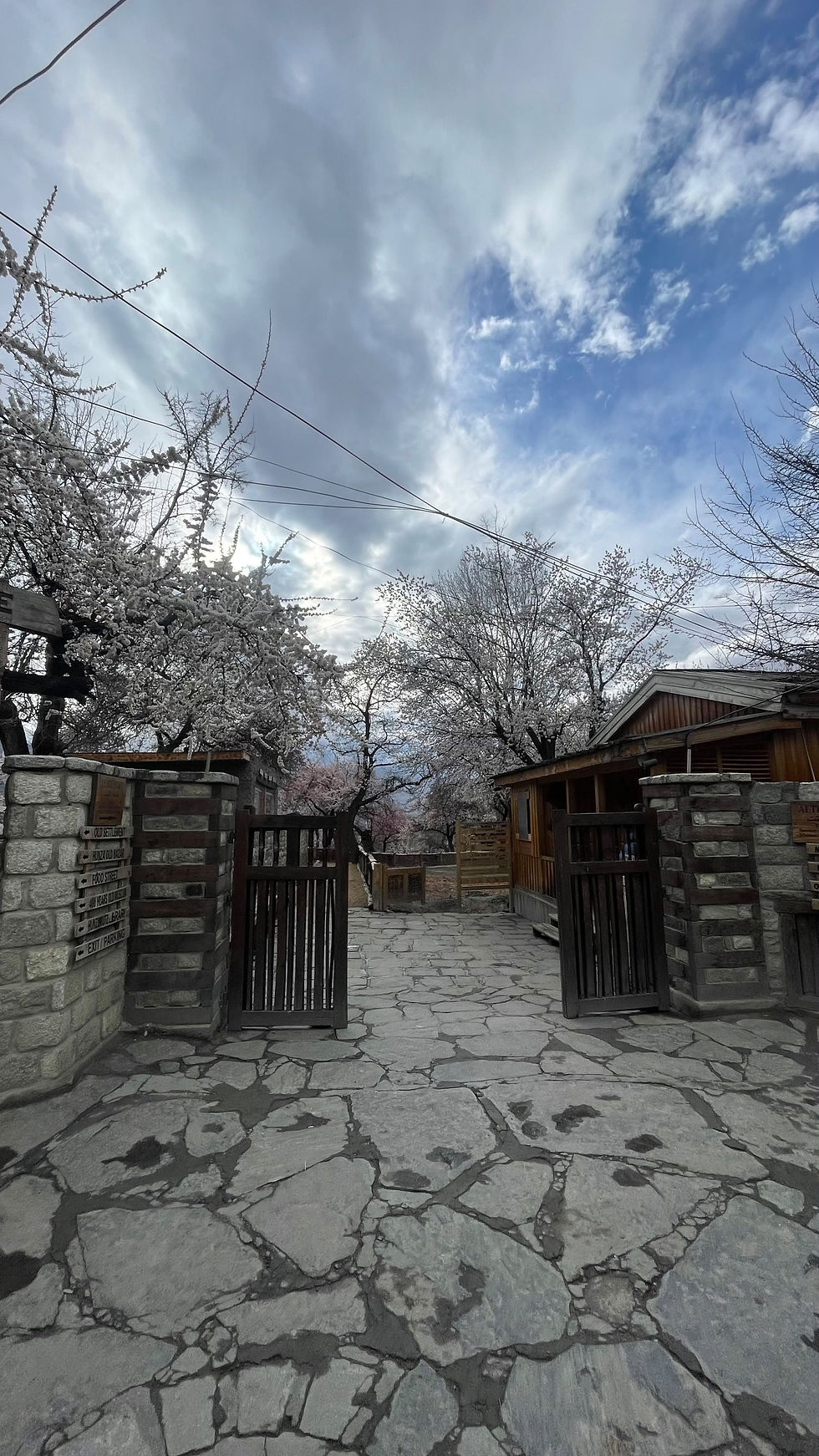
From the rooftop of Altit Fort, I can see the whole village below. I can see around 400 small homes, each with a skylight. The doors are small so that attackers would have to attack one by one. The whole village has a boundary of big wall and the wall has 11 watch towers on it for surveillance. On the top of the tower, there is a wooden statue of an Ibex: this is to warn their enemies the message that if they attacked, this is where they would end up.

I’ve now opened my bag and started eating some snacks while sitting at the edge of the rooftop.
Looking at the jaw-dropping view, I’ve introduced myself to a different venue of our lives. The royal family is no more, but the building remains, as a monument. Royalty, wealth and superiority are nothing; the best thing that a human being can do is serve others with love and care. Everything fades away, but our words do not. I zip up my bag and start taking a long breath to feel life.
La vie est belle.
All photographs courtesy of the author.

Misbah Uddin was born in the beautiful valley of Altit, Hunza and holds a Baccalaureate (Hons.) degree in English Literature from Forman Christian College University, Lahore. In recognition of his academic excellence, he received the Magna Cum Laude Award, Core Values Award, Community Service Award, and Vice Rector's Award. Misbah has remained a dedicated writer and presented his research papers at international conferences. He writes creative nonfiction and loves literary aspects of feminism, specializing in Modern Black Feminism. His debut novel, Hello One Pen, soon to be launched, highlights the struggles of young mountain people in the pursuit of education.


Misbah has a rare gift of noticing little things and turning them into something beautiful in his writings! ✨
Nicely articulate! Nailed it
Great. Keep it up!
Wow, amazing! I love nature, and reading your article made me feel like I was right there in the mountains. I hope to see more articles soon, and I'm eagerly waiting for your "hello one pen" book.
Amazing work.
Keep it up